Thursday, April 30, 2015

The Torah Hidden in Prayer

Rabbi Nachman, commenting on the Talmudic dictum that the Torah was meant to be given after one thousand generations, but was, in fact, given after twenty six generations, because of "arrogant people", as follows:
The world was created in "Ten Utterances". These utterances contain the "Ten Commandments". That is, there is a "Hidden Torah" in nature itself. People who are spiritually attuned can perceive this Torah. However, there will always be scoffers who say "he's not real, he's a phony" thereby keeping people away from these Tzaddikim. Finally, the Torah had to be given in writing, so as to make it accessible to all, even without the Tzaddikim. The time before Matan Torah (the giving of the Torah), there were few laws. This is why Psalm 136 contains 26 verses, all ending in "for his Chesed (kindness) endures forever". These twenty six verses correspond to the twenty six generations that lived purely by HaShem's Chesed. Rabbi Nachman goes on to say that this "Treasury of Free Gift" still exists, and is accessible at times when Torah study is impossible. We can "tune in" to the hidden Torah in nature. At one point returning from his famous journey to Eretz Yisrael, he was captured by pirates who planned to sell him into slavery. He later said that had this happened, he would have survived on this hidden Torah.
His student, Rabbi Natan, connected this to a Talmudic debate concerning the relative merits of Torah study and prayer. One view is "Would that a person would pray all day!". The other view is that we should not pray too much, as "we abandon Eternal Life (Torah), in favor of Temporal Life (Prayer, in which we pray for sustenance, health, etc.) Rabbi Natan connects this idea of "Temporal Life" with the Hidden Torah in nature. When we pray, we ARE studying the Torah...the Hidden Torah, finding G-d in everyday life, where we were originally supposed to find Him. Our health and wealth are not accidents, but they come from the Treasury of Free Gift. Yes, we need to study, but prayer can be the ultimate study. It all depends on how we pray.

Tuesday, April 28, 2015

Women's Education

When I lived in Israel, I met a a neighbor's wife on a bus going from the Beit El settlement, where we lived, to Jerusalem. I asked her what she was going to do in Jerusalem. She informed me that she was taking a course to become a "to'entet"; a lawyer in the rabbinic court system. She further told me that her course, besides being practical, was also an eye opener, She had gone through religious schooling all of her life, but only now understood how Judaism works. I immediately grasped her meaning. Girls and women are usually taught a very black-and-white Judaism. Do this, don't do that. The fact is that men's Yeshiva classes analyse and discuss rabbinic opinions. They understand that almost nothing in Judaism or halachah is simple. They are taught how to sift through information, and arrive at conclusions. This is true not only in halachah (Jewish Law) but also Hashkafah (thought, philosophy). RAMBAM's concept of the Mashiach, for example, bears little resemblance to that of RASHI. Men are taught that. Women and girls are generally taught "this is the Torah's view". In my opinion, besides this being a patronizing (and paternalistic!) approach, this robs women of the ability to analyze things for themselves, and robs the Jewish community of women's talents, and women's unique thought processes. We must remember that women's organized Torah education only began a little over a hundred years ago. It is still finding its way. Some schools have implemented the advice of Rabbi J.B. Soloveichik to give girls a thorough background in all areas of Torah. Most are still reticent to do so. On the other hand, we must be careful not to throw out the baby with the bath water. Many feminist Jewish groups seek to undermine rabbinic authority, and insist that the Torah be interpreted by each individual; whether or not they have a grasp of the halachic process! There must be a middle ground that is inclusive of women, teaches them the facts the same way that the men are taught, or else we risk drive them away into bizarre cult-like behavior. I hope and pray that solutions will be found.

The Yemenites part 6


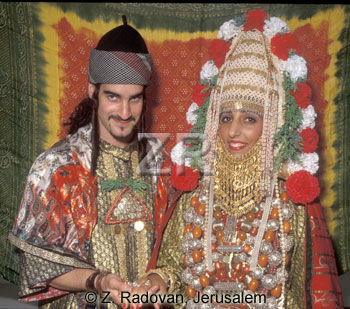
While in Yemen, the Jews kept Talmudic wedding traditions which have long since died out in other communities. However, in Israel, and other lands in which Yemenites have settled, many of these traditions have gone by the wayside, in favor of other practices more common in their new environment.
As I wrote about in my series "Jewish Marriage", the wedding ceremony actually consists of two ceremonies; the Kiddushin, which "consecrates" the bride to her groom, but does not yet permit her to him. She is, however, forbidden to every other man, and the Nissuin, which permits her to the groom. Nowadays these are done together (this is the reason for two cups of wine at the wedding). In Talmudic times, they were held some time apart, in order to allow the bride to prepare all of her needs in her new home. These were sometimes held as much as a year apart. In Yemen, the Kiddushin ceremony was performed in the evening, with little fanfare. The following morning the Nissuin were held in front of the home where the couple were to live. The most honored men in the community would dress the groom, while the most honored women  would dress the bride. As the  ceremony was  done in the public street, an early hour (shortly after sunrise) was the usual time for the wedding, in order to minimize outsiders gawking at the sacred rites.  Many features which we associate with Jewish weddings were absent. There was no canopy ( a medieval Ashkenazic custom), no ring (a silver coin was used instead), and no breaking of a glass. The colorfully dressed bride and groom were now prepared to marry. In the Yemenite tradition, it was the groom, not the rabbi, who was to recite the wedding benedictions. However, so as not to embarrass an unlearned groom  (rare in Yemen!), someone (usually the rabbi) would recite the benedictions along with the groom. The Huppah, which is what other communities call the marriage canopy,was originally a specially built hut where the couple would consummate the marriage, and would hold celebrations for seven days. In Yemen, the couple's new home became the "hut", richly decorated with tapestries and other ornaments. The couple, immediately after the ceremony, would enter the home, and stay secluded for sufficient time that that relations could conceivably have taken place. They were now officially married! A feast was held outdoors. Remarkable to us, there were no actual musical instruments. This is in keeping with the Talmudic prohibition of musical instruments after the destruction of the Second Temple. Most other communities do not observe this prohibition, citing our need to be gladdened in the midst of our woes. In the "Old Yishuv", the centuries old Ultra-Orthodox community of Jerusalem, one single instrument is allowed at a wedding. The Yemenites, ever resourceful, have developed a uniquely beautiful system of making music...on old tin cans and oil drums. Unlike most Orthodox communities, where celebrations are held for seven days at the homes of friends and relatives, in Yemen, the friends and relatives would prepare feasts and bring them to the  couple's new home. Time is given for the two to be alone, and become one.
Today, we find many combinations of Yemenite and non-Yemenite customs observed at weddings. I have witnessed every possible combination and permutation of the old and the new. Throughout it all, however, the uniqueness and beauty of the ancient path shine through.

Thursday, April 23, 2015

The Yemenites part 5


Perhaps the most impressive Yemenite event is a wedding, together with the prenuptial celebrations. About a week before a wedding, the bride and groom attend a "Henna" celebration. This tradition is common in the Middle East among Muslims, and is also observed by North African Jews. But no one does it as elaborately as the Yemenites. The bride and groom are dressed in elaborate costumes, both for the Henna ceremony and the wedding. The Talmud records that brides in ancient Israel were adorned with twenty four ornamental garments. The Kabbalah connects this with the twenty four books of the Hebrew Bible. The bride represents the Shechinah; the Divine Feminine, the supernal source of the Jewish People. The books of Scripture are G-d's ornaments for his "bride". The human bride must reflect this. (The custom of staying up all night on Shavuot, the day of the Giving of the Torah, is understood Kabbalistically as "dressing the bride" for her wedding at Sinai. Hence, Kabbalists are careful to study excerpts of all twenty four books, symbolizing the twenty four ornamental garments.) Henna is a leaf, that when crushed, is made into an orange paste. This paste is placed in baskets with candles, often adding bottles of Arak, a liquor used in many celebrations by Eastern Jews. The baskets are carried on women's heads, while ecstatic drum music plays. An older woman, usually the bride's grand mother, will then place Henna on the bride's hands and feet, often in elaborate patterns. The original idea behind this was to ward off the "evil eye", but Jewish tradition took it much further. In Song of Songs, there is mention of the groom giving his bride "eshkol hakofer" (a bundle of henna). RASHI comments that this symbolizes forgiveness. There is an ancient Jewish belief, recorded in the Talmud, that on one's wedding day, G-d forgives the sins of the bride and groom. It is a new start! In Ashkenazi tradition, the bride and groom fast on their wedding day in recognition of this. The custom of fasting for one's wedding is unknown among Eastern Jews. For Yemenites and North Africans the wearing of the Henna is the primary symbol. In addition, the word "henna", is seen as being an acrostic of the three distinctly feminine mitzvot; Nidah (the laws of family purity), Hallah (taking off a portion of dough when baking bread, originally given to the Kohen, and Hadlakat HaNer (the kindling of the Shabbat lights). Afterwards, all present have some henna placed on their hands. The orange stain remains on the skin for at least a week, and is therefore present at the wedding itself. An evening of feasting and dancing follows the ceremony I will discuss the wedding itself in my next post.
Like · Comment · 

Wednesday, April 22, 2015

The Yemenites part 4


For many years after Maimonides, the Yemenite community followed his path both in Halachah (Jewish law), which, as we have seen, was very close to their own ancient practices, and in his philosophical approach to Jewish theology. Beginning in the 14th century, and greatly increasing in the 17th century, the ideas of Kabbalah came to Yemen. Now, there were (and are) Jewish groups who attempt to reconcile the philosophy of Maimonides with the mysticism of the Kabbalah, However, most regard these two understandings as mutually exclusive. I have discussed this conflict in an earlier series on Kabbalah. In the following centuries, the theology of Yemenite Jews shifted to Kabbalah, while largely maintaining the practices of Maimonides' Code. A great Yemenite rabbi and scholar, Rabbi Yihya Saleh (c. 1800) wrote extensively on Yemenite traditions and law, reconciling them with the teachings of the Kabbalah, and weighing in on when to alter a practice based on Kabbalah. This group is known as the Baladi Yemenites, from the Arabic word Balad; a country. This was considered the "native" Yemenite tradition. In many areas, however, Jewish religious tracts from Syria, Iraq and the Holy Land made a major impression, especially the Shulchan Aruch of Rabbi Yosef Karo (1565). Many (probably the majority) accepted these works as authoritative. They maintained the framework of ancient Yemenite ways, but changed to a Sephardic prayer book, and adopted most of the legal rulings of the Sepharadic world (except where Maimonides is adamant about a practice. This is especially true in the way in which blood is removed from meat, in which Maimonides considered what is done in most communities as insufficient and invalid. In cases like this, and some similar cases,they maintained the Maimonist practice.) This group became known as the Shamis, from Sham, the Arabic name for Damascus. A sub-group called Shar'abis (from the city of Shar'ab) adopted the Sepharadic rulings and customs completely. These divisions still exist, and one often hears heated debates between Baladis and Shamis as to who is "right".
Another dispute and division arose in the late 19th and early 20th century. A group of rabbis, led by Rabbi Yihyah Kappah (Kafih), began urging Yemenites to return to the original teachings of Maimonides, and rid Yemenite life of foreign influences in halachah. By 1920, a complete schism existed. Ironically, while eliminating outside influence in practice and theology, they urged the study of secular wisdom, which, after all, was a major part of Maimoides; teachings. At the same time, they thoroughly rejected the teachings of Kabbalah, regarding them as violating Maimonides' rationalist approach. This movement is called "Darda'". (A contraction of "Dor De'ah", "a generation of knowledge", although they vehemently deny any connection with others who have taken that name). The Darda' and anti-Darda' Baladis still argue, although most of the old antagonism is gone. The leader if the Darda' in recent times was the grandson of its founder, Rabbi Yosef Kappah (1917-2000). While proudly maintaining the Darda' way (he wrote a 23 volume exposition of Maimonides' Code, as well as numerous books on Maimonides' philosophy), he nevertheless was both respectful and conciliatory to those with whom he differed. Interestingly, he maintained close ties with the Lubavitcher Rebbe, and they quoted each other often. I had the distinct honor and pleasure of meeting him. The word "Impressive" doesn't begin to touch the man's greatness. I continue studying his writings every day, even though I am a devote of Kabbalah.
When I have seen squabbles between Jewish groups, it's usually about "my grandfathers customs are better than your grandfather's customs". But when one sees Yemenited arguing, they will show you chapter and verse in Talmud, Maimonides' Code, and the vast literature of a thousand (or more!) years of scholarship. Each side knows exactly why they follow what they do. It is a dispute truly for "the sake of heaven" We all can learn much from our Yemenite brothers and sisters.

Tuesday, April 21, 2015

The Yemenites part 3


Maimonides was faced with a difficult choice. Should he risk his position...and his life...in order to respond to the pleas from Yemen? Would his intervention really accomplish anything? He finally decided that he must save a Jewish community from physical and spiritual destruction, even at his own personal peril. In 1172, he wrote his Iggeret Teiman (Epistle to Yemen). He asked that it not be passed around in writing, but copies should be only in the hands of the rabbis, who will read them to the community. He deals with all three crises; the forced conversion that was going on, the "proofs" of a Jewish apostate in favor of Islam, and the claims of the false Messiah. He first urges his fellow Jews to be aware that all of their suffering is a preparation for the final Redemption. They must not lose their faith and hope. Although he enters into a polemic against both Christianity and Islam, his main thrust is that the Torah itself declares itself as eternal, never to be changed. Its laws are divine and immutable. What sense would it make to have statements to this effect contradicted by vague "hints"? Any gematria, or "hidden messages" in spelling that contradicted a Torah precept must be seen as illogical and plain wrong. It is a fact that over the centuries, many non-Jewish, and some downright pagan or superstitious ideas and practices have crept into Jewish folk religion. Maimonides fought these tooth and nail. How much more so for practices and ideas that openly contradict the Written and Oral Torahs? Therefore, the best refutation of other faiths is the Torah itself, rather than considering the other faiths' claims point by point., As to the Messiah, Maimonides lists certain conditions for even considering a person as a candidate for Mashiach. In order to accept him as definitely Masiach, he must accomplish several things; gather in the exiles, rebuild the Temple, and initiate World Peace. Barring these criteria, a claimant must be seen as a charlatan or a madman. Judaism has no concept of accepting someone "on faith".
His position on forced conversions was very brave and innovative. Jewish law and tradition dictate martyrdom when faced with the prospect of acknowledging idolatry. Was it necessary for those being coerced to accept Islam to die a martyr's death? Countless lives were at stake here. Maimonides makes clear that although he in no way accepts the tenets of Islam, nevertheless, it is anything but idolatry. In several of his works he acknowledges that Islam has a concept of the Unity of G-d "which is beyond reproach". He rails against those who claim otherwise, urging them not to make false accusations about others, merely because they make false accusations against us (especially the claim that we have falsified the Torah). I know that many of you will disagree. I see posts on Facebook every day to the contrary. Please do not debate with me, but take it up with Maimonides. He knew both Islam and Judaism far better than any of us. Therefore, conversion was preferable to death. Whatever mitzvot can be kept in secret must be done. Just as the regime had changed to an intolerant one, it would certainly change back before too long. At that time, they could openly return to Judaism. He did not make this concession to any other faith, as he considered Islam the only truly Monotheistic faith besides Judaism. (I have already written that there are other views which would extend this to additional faiths). With this approach, the Yemenite community was able to weather the storm. Judaism could, and did, survive. Superstitious use of Scripture was shown as a real and present danger, and crackpots were to be seen and branded as such. Maimonides was close with Saladin, and was able to get the orders of persecution rescinded. But the lasting effects of Iggeret Teiman were twofold. First, the ancient beliefs of Yemenite Jewry had been validated. He had confirmed their approach of faithfulness to sources, being rational and circumspect about revisionism. Second, these ideas became known and accepted throughout Middle Eastern Jewry, and served as a vital guide when persecution came.
As a tribute, the Yemenites added to the Kaddish prayer for some time "In your life time, in your days, in the life of all Israel, in the life of Our Teacher Moshe ben Maimon." Maimonides had saved them from needless martyrdom, and had further purified an already great tradition.
With time,other ideas came into the Yemenite community, and resulted in the formation of factions and strife, which still exist to this day. That will be my next post.

Monday, April 20, 2015

The Yemenites part 2


A non-Yemenite rabbi whose name will forever be associated with that community is Moses Maimonides (1138-1204), known and beloved by the Jewish world by the acrostic RAMBAM, but by the Yemenites simply as Rabbenu (our rabbi, our teacher). He is seen by most as the predominant posek (legal decisor) of all times (although some feel that that distinction belongs to Rabbenu Tam). About seventy percent of Sepharadic halachah is based on his rulings, with a somewhat smaller percentage for Ashkenazim. Born in Spain, spending his youth in Morocco, finally coming to Egypt where he became physician to the Royal family. Although Jews fared much better in Muslim countries than they did in Christian ones, there were, nevertheless periods of persecution and forced conversion in Muslim countries as well, depending on who was in power. His family first fled Spain because of an intolerant Muslim regime, and he later needed to flee Morocco for the same reason. The Muslim rulers of Egypt, however, were enlightened leaders who encouraged the exchange of ideas between religions and philosophies.
The Yemenite community carried on an active correspondence with Maimonides. They were on the same "wavelength". Maimonides carefully sifted through all classical sources in order to render a decision. He engaged in little "svara", theoretical analysis extrapolating new practices by connecting them to accepted ideas. Yemenites shuddered at the thought of changing ancient practices based merely on a theoretical interpretation by a recent or contemporary scholar. Maimonides shared their contempt for innovation. He not only sent them his books, but wrote them many responsa that were unknown, until the last hundred years, outside of Yemen. Although there were a handful of Yemenite traditions that Maimonides disagreed with, the Yemenites only accepted his words and altered their practices if his arguments seemed logical and cogent.Otherwise, they remained faithful to their heritage. In the great majority of cases, however, they saw Maimonides as the great interpreter of the very tradition that they had followed for many centuries. Classical Yemenite Judaism is about 99% in line with Maimonides.
At this time, Yemenite Jewry faced three major problems that threatened their continued existence. First, a new regime had taken over that was engaged in forced conversion of Jews. Besides this, a Jewish convert to Islam was claiming that he had found a Torah reference to Muhammad. This was making many Yemenite Jews wonder if, perhaps, conversion was what they should, in fact, be doing. (The argument was that, in the Torah, G-d said that he would bless Yishmael "B'meod Meod", which means 'very much'. However, every Hebrew letter has a numerical equivalent (Gematria). The Gematria of B'meod Meod is 92, the same as Muhammad). On top of all this, a claimant to Messiahship had arisen, and people wondered if this might not be, in fact, the promised redeemer. The then head of the Yemenite community, Jacob ben Netanel, wrote to Maimonides. setting out the situation, asking for guidance and encouragement. This was a most difficult request to make of a rabbi who was also a court official in the employ of a Muslim ruler. How could he respond? Would be not be endangering not only his position, but his life? How could a rabbi fifteen hundred  miles away deal with the turmoil taking place in Yemen? Perhaps Yemenite Jewry was a lost cause? How this was handled will be the topic of my next post.