Wednesday, May 6, 2015

Hermeneutics

Hermeneutics
Hermeneutics is the scholarly term for rules of Biblical interpretation. The Talmud records several methodologies. One is the Seven Rules of Hillel. These were later expanded by Rabbi Yishmael into thirteen rules (or Middot). These are actually recited in the morning prayers. Rabbi Akiva had a totally different methodology, based on extra or missing words or letters, the use of inclusive words (like "and" or "with") and limiting words (like "but" or "only"). Both methods were employed in the Talmud. Another set of thirty two rules was presented by Rabbi Eliezer ben Rabbi Yosi Hagalili. These later rules were intended not for halachic (legal) exposition, but for aggadic (homiletic, metaphorical) interpretation.
Why bother? Why not just take the text literally? Allow me to pose the following question. Where does the Torah (or any Biblical book) forbid sexual relations between a father and daughter? IT DOESN'T!.Among the incestuous relationships forbidden by the Torah, some blood relatives and some not, we search in vain for what would seem to be a most basic abomination! However, the Talmud points out that we DO find a prohibition of relations with a granddaughter. We have here an argument called "kal V'chomer" (from the minor towards the major). If a granddaughter is forbidden, how much more so a daughter! Is this rabbinic law? NO! It is seen as Biblical; validly derived by the rules that have been handed down to us. (There were, in fact, some views outside the rabbinic tradition that DID allow such a union. See 1 Corinthians 7:36).
But why wouldn't the Torah specify ideas like this? The Torah is a Divine document, far beyond human comprehension, with layers of meaning that remain yet to be discovered. It was revealed with explanation, guidelines, hints to be used in interpretation. There is no extraneous letter. It is written tersely, yet it contains every imaginable (and many beyond imagination) secret and mystery.
I like to think of this as analogous to romantic love. No one EVER really knows another person. In fact, we don't really know ourselves! Yet, when we have known someone for a relatively short time, we may realize that we love them. If it is a good relationship, love matures and grows. Even after several decades, we discover aspects of the other person that make us love them even more! We realize how without that person, how dark our lives would have been! So it is with the Torah. As children, we sit wide-eyed at the telling of the story of the Great Flood, the Exodus, the splitting of the Sea. As we mature and continue studying, we get to know the Torah better. Each story has lessons vital FOR ME! And as we encounter new challenges in life, the Torah provides new answers! We love the Torah when we are children, but love her so much more by the time we have weathered numerous life challenges. We realize that G-d's teachings and guidance are so intricately woven, that each thread tells us exactly what we need, that we may well have overlooked while examining the entire fabric.
I noted above that the thirteen rules of interpretation are in our daily prayers. Why would they be in a prayer? The Kabbalists inform us that these thirteen Torah rules are inextricably bound up with the Thirteen Attributes (also called Middot!) with which we implore G-d's Mercy. If we are studying the Torah correctly, it becomes a prayer. If we pray correctly, finding G-d in all the ups and downs of life, prayer opens up the Torah for us in a new way. Prayer can be the ultimate Torah study! The Zohar says that if the Torah was only what we read on the surface, we could write a much better Torah. But that is NOT the Torah. There are ins and outs, permutations, like a great poem combined with the most personal prayerful devotion, that grows as we grow, and offers ever-widening vistas.

Monday, May 4, 2015

The Asmachta

I have written several times in the past about the centrality of Deuteronomy 17:5-13, which is the very foundation of the Oral Torah and rabbinic authority. When there is a question of how to follow a Torah command, we are to turn to the sages, priests and prophets who formed a central court, later known as the Sanhedrin. We are commanded to follow their teachings, instructions and enactments. With the demise of the Sanhedrin in the fourth century CE, rabbinic authority remains, albeit in a limited form. According to RASHI and most Ashkenazic authorities, the power of the Oral Torah shifted to all the Torah Greats in a generation, who, in a sense, form a kind of Sanhedrin. According to RAMBAM, followed by most Sepharadic opinion, rabbinic authority only extends to a community's rabbi, with no powers beyond his own community. In any case, the Torah is not for individual interpretation of practices, but comes with instructions! Without the Sages, the Written Torah is a closed book.
A fascinating part of the Oral Torah is known as an "Asmachta" (Aramaic for "leaning"). The Torah empowers the sages to enact legislation to protect the Torah ("fences around the Torah"), without adding to the number of Biblical laws. Sometimes, the sages would "lean" a purely rabbinic law on a Biblical text. For instance, the Torah commands us to tie the Tefillin on our arm and head. But which arm? The rabbis had received a clear tradition that it was the left arm (for lefties, most agree that they are to put the tefillin on the right arm). This was always part of the Oral Torah. But the Talmud, the central work of the Oral Torah, says that, in fact, there is a Biblical reference to this idea. Of the four places where the Torah commands Tefillin, in one place, the word "Yadecha" (your hand/arm) has an unusual spelling, so that it can also be read "weaker arm". Now, no one would argue that this is the literal meaning of the verse. Rather, the idea has been "leaned" onto the verse for support. Here, we have two interpretations. One view is that the asmachta was simply a device used to give SOME Biblical authority to a rabbinic enactment. Another, far more accepted view, is that, in fact, the Torah has not as yet revealed all of her secrets. The Torah is wider than the seas, vaster than the Heavens. Besides the laws clearly given in the Torah, or handed down by oral tradition, the Torah contains infinite "hints". Some may be universal, some may apply to a given time, place or situation. Some may even be individual. Some great Tzaddikim, when asked a question, may open a Torah text at random, and find the answer there! (I have seen this with my own eyes). Therefore, "minor" variations in spelling, grammar or syntax can actually be hints to sages of future generations as to how to act in a given situation. The unusual spelling of "Yadecha" was put there by G-d Himself, to guide the sages should a question arise. Over the last seventy years, many rabbis have discovered cryptic  messages in the Torah that were previously unknown, by certain letters occurring at certain intervals (every twenty-fifth letter, for example) which spell out a clear message.
The rabbis tell us that the Torah existed for two thousand years before the world was created. Although there are many interpretations of this idea, one thing is certain. I, you, every man, woman and child who ever lived or will live is in the Torah. The Sages can see this, and guide us accordingly. We must be aware that the Torah is not just a book. The Zohar states that the first word in the Ten Commandments (Anochi/I am) is an acrostic of "ana nafshi ketavit yehavit" (I wrote and gave you My Self). When we touch the Torah, we touch G-d. But we need to learn from those who know how to see this and make it into a reality in our lives.

Friday, May 1, 2015

Hora'at Sha'ah and the Second Passover


The "Hora'at Sha'ah" (ruling for the hour), is a provision in Jewish Law that allows a prophet, a beit din(court) or even a community rabbi, to decide that in extraordinary situations, a law, even a Biblical law, could be set aside for a greater good. The Hora'at Sha'ah is a one time thing, setting no precedent for future actions. The most famous case is to be found in the story of Elijah. The people were unsure whether to worship G-d or the pagan deity, Baal. Elijah challenges the Priests of Baal to a contest. They will offer sacrifice to Baal, he will offer sacrifice to G-d. Neither would light fire under their altars, but ask for fire to come down from Heaven. The Baalites fail, Elijah succeeds.The people now shout "G-d is G-d!". This beautiful story raises two obvious questions. One, how was Elijah allowed to not only condone, but actually encourage, a pagan sacrifice? Secondly, how was he allowed to offer sacrifice outside the Temple, which then stood in Jerusalem, apparently violating the law of the central sanctuary? The rabbis explain that this was a Hora'at Sha'ah. The people were straying from G-d, and extraordinary measures were necessary.
The sixteen year rule of Ahaz, King of Judah, was marked by apostasy and persecution of everything holy. At his death, he was succeeded by his righteous son, Hezekiah. Hezekiah was faced with the need to bring the people back to G-d. It is not an exaggeration to say that Judaism could very well have ended then, if not for Hezekiah's determined actions. The Bible records that Ahaz was not accorded a Royal burial. The Talmud elaborates; Hezekiah had his father's remains dragged by horses on a bier of reeds. A firm statement needed to be made, even at the expense of dishonoring his own father. In the first year of his reign, Hezekiah reopened the Temple, which had been closed by Ahaz. He knew that something must be done quickly to bring the people back to G-d. He decided that the right time for this would be Passover. But there was a problem. The Temple, the Priests, the people were not ready. It was too short notice! He needed more time! In II Chronicles 30, we read that he made a huge Passover...in the Second Month! The Torah commands that Passover be in the First Month (Nisan). Here there are two interpretations. One is that he added an additional month (as we do on a leap year) in order to make Passover come out later and give him more time. Since this was done not following the usual rules of leap year, it SEEMED like the Second Month. However, some interpret differently. There is a provision in the Torah that one who was unclean or on a journey could bring the Passover sacrifice on the same date in the following month. This is called Pesach Sheni (the Second Passover). However, this was only for individuals; not the community. According to this view (which appears to be the literal understanding of the text), Hezekiah made a hora'at sha'ah, instituting FOR THAT YEAR that everyone should observe Pesach Sheni. The Bible even notes that it was "not as written"; he had not abided by the usual rules. Scripture tells us that Hezekiah asked G-d to "heal" (forgive) the people who were not properly purified for this ceremony. G-d did! Many scoffed at Hezekiah's idea, but most celebrated as had not been done for many years. The people had come back to G-d! He probably saved Judaism.
Many  people eat a piece of matzah on Pesach Sheni  as a reminder. But let us also remember the good King Hezekiah, whose foresight and bravery kept us as the people of G-d. Let us be determined to remain that way!

Thursday, April 30, 2015

The Torah Hidden in Prayer

Rabbi Nachman, commenting on the Talmudic dictum that the Torah was meant to be given after one thousand generations, but was, in fact, given after twenty six generations, because of "arrogant people", as follows:
The world was created in "Ten Utterances". These utterances contain the "Ten Commandments". That is, there is a "Hidden Torah" in nature itself. People who are spiritually attuned can perceive this Torah. However, there will always be scoffers who say "he's not real, he's a phony" thereby keeping people away from these Tzaddikim. Finally, the Torah had to be given in writing, so as to make it accessible to all, even without the Tzaddikim. The time before Matan Torah (the giving of the Torah), there were few laws. This is why Psalm 136 contains 26 verses, all ending in "for his Chesed (kindness) endures forever". These twenty six verses correspond to the twenty six generations that lived purely by HaShem's Chesed. Rabbi Nachman goes on to say that this "Treasury of Free Gift" still exists, and is accessible at times when Torah study is impossible. We can "tune in" to the hidden Torah in nature. At one point returning from his famous journey to Eretz Yisrael, he was captured by pirates who planned to sell him into slavery. He later said that had this happened, he would have survived on this hidden Torah.
His student, Rabbi Natan, connected this to a Talmudic debate concerning the relative merits of Torah study and prayer. One view is "Would that a person would pray all day!". The other view is that we should not pray too much, as "we abandon Eternal Life (Torah), in favor of Temporal Life (Prayer, in which we pray for sustenance, health, etc.) Rabbi Natan connects this idea of "Temporal Life" with the Hidden Torah in nature. When we pray, we ARE studying the Torah...the Hidden Torah, finding G-d in everyday life, where we were originally supposed to find Him. Our health and wealth are not accidents, but they come from the Treasury of Free Gift. Yes, we need to study, but prayer can be the ultimate study. It all depends on how we pray.

Tuesday, April 28, 2015

Women's Education

When I lived in Israel, I met a a neighbor's wife on a bus going from the Beit El settlement, where we lived, to Jerusalem. I asked her what she was going to do in Jerusalem. She informed me that she was taking a course to become a "to'entet"; a lawyer in the rabbinic court system. She further told me that her course, besides being practical, was also an eye opener, She had gone through religious schooling all of her life, but only now understood how Judaism works. I immediately grasped her meaning. Girls and women are usually taught a very black-and-white Judaism. Do this, don't do that. The fact is that men's Yeshiva classes analyse and discuss rabbinic opinions. They understand that almost nothing in Judaism or halachah is simple. They are taught how to sift through information, and arrive at conclusions. This is true not only in halachah (Jewish Law) but also Hashkafah (thought, philosophy). RAMBAM's concept of the Mashiach, for example, bears little resemblance to that of RASHI. Men are taught that. Women and girls are generally taught "this is the Torah's view". In my opinion, besides this being a patronizing (and paternalistic!) approach, this robs women of the ability to analyze things for themselves, and robs the Jewish community of women's talents, and women's unique thought processes. We must remember that women's organized Torah education only began a little over a hundred years ago. It is still finding its way. Some schools have implemented the advice of Rabbi J.B. Soloveichik to give girls a thorough background in all areas of Torah. Most are still reticent to do so. On the other hand, we must be careful not to throw out the baby with the bath water. Many feminist Jewish groups seek to undermine rabbinic authority, and insist that the Torah be interpreted by each individual; whether or not they have a grasp of the halachic process! There must be a middle ground that is inclusive of women, teaches them the facts the same way that the men are taught, or else we risk drive them away into bizarre cult-like behavior. I hope and pray that solutions will be found.

The Yemenites part 6


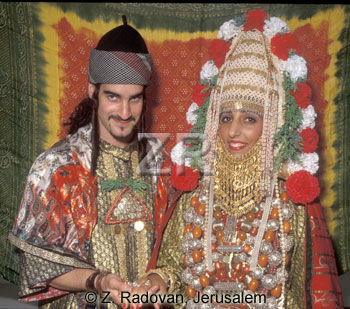
While in Yemen, the Jews kept Talmudic wedding traditions which have long since died out in other communities. However, in Israel, and other lands in which Yemenites have settled, many of these traditions have gone by the wayside, in favor of other practices more common in their new environment.
As I wrote about in my series "Jewish Marriage", the wedding ceremony actually consists of two ceremonies; the Kiddushin, which "consecrates" the bride to her groom, but does not yet permit her to him. She is, however, forbidden to every other man, and the Nissuin, which permits her to the groom. Nowadays these are done together (this is the reason for two cups of wine at the wedding). In Talmudic times, they were held some time apart, in order to allow the bride to prepare all of her needs in her new home. These were sometimes held as much as a year apart. In Yemen, the Kiddushin ceremony was performed in the evening, with little fanfare. The following morning the Nissuin were held in front of the home where the couple were to live. The most honored men in the community would dress the groom, while the most honored women  would dress the bride. As the  ceremony was  done in the public street, an early hour (shortly after sunrise) was the usual time for the wedding, in order to minimize outsiders gawking at the sacred rites.  Many features which we associate with Jewish weddings were absent. There was no canopy ( a medieval Ashkenazic custom), no ring (a silver coin was used instead), and no breaking of a glass. The colorfully dressed bride and groom were now prepared to marry. In the Yemenite tradition, it was the groom, not the rabbi, who was to recite the wedding benedictions. However, so as not to embarrass an unlearned groom  (rare in Yemen!), someone (usually the rabbi) would recite the benedictions along with the groom. The Huppah, which is what other communities call the marriage canopy,was originally a specially built hut where the couple would consummate the marriage, and would hold celebrations for seven days. In Yemen, the couple's new home became the "hut", richly decorated with tapestries and other ornaments. The couple, immediately after the ceremony, would enter the home, and stay secluded for sufficient time that that relations could conceivably have taken place. They were now officially married! A feast was held outdoors. Remarkable to us, there were no actual musical instruments. This is in keeping with the Talmudic prohibition of musical instruments after the destruction of the Second Temple. Most other communities do not observe this prohibition, citing our need to be gladdened in the midst of our woes. In the "Old Yishuv", the centuries old Ultra-Orthodox community of Jerusalem, one single instrument is allowed at a wedding. The Yemenites, ever resourceful, have developed a uniquely beautiful system of making music...on old tin cans and oil drums. Unlike most Orthodox communities, where celebrations are held for seven days at the homes of friends and relatives, in Yemen, the friends and relatives would prepare feasts and bring them to the  couple's new home. Time is given for the two to be alone, and become one.
Today, we find many combinations of Yemenite and non-Yemenite customs observed at weddings. I have witnessed every possible combination and permutation of the old and the new. Throughout it all, however, the uniqueness and beauty of the ancient path shine through.

Thursday, April 23, 2015

The Yemenites part 5


Perhaps the most impressive Yemenite event is a wedding, together with the prenuptial celebrations. About a week before a wedding, the bride and groom attend a "Henna" celebration. This tradition is common in the Middle East among Muslims, and is also observed by North African Jews. But no one does it as elaborately as the Yemenites. The bride and groom are dressed in elaborate costumes, both for the Henna ceremony and the wedding. The Talmud records that brides in ancient Israel were adorned with twenty four ornamental garments. The Kabbalah connects this with the twenty four books of the Hebrew Bible. The bride represents the Shechinah; the Divine Feminine, the supernal source of the Jewish People. The books of Scripture are G-d's ornaments for his "bride". The human bride must reflect this. (The custom of staying up all night on Shavuot, the day of the Giving of the Torah, is understood Kabbalistically as "dressing the bride" for her wedding at Sinai. Hence, Kabbalists are careful to study excerpts of all twenty four books, symbolizing the twenty four ornamental garments.) Henna is a leaf, that when crushed, is made into an orange paste. This paste is placed in baskets with candles, often adding bottles of Arak, a liquor used in many celebrations by Eastern Jews. The baskets are carried on women's heads, while ecstatic drum music plays. An older woman, usually the bride's grand mother, will then place Henna on the bride's hands and feet, often in elaborate patterns. The original idea behind this was to ward off the "evil eye", but Jewish tradition took it much further. In Song of Songs, there is mention of the groom giving his bride "eshkol hakofer" (a bundle of henna). RASHI comments that this symbolizes forgiveness. There is an ancient Jewish belief, recorded in the Talmud, that on one's wedding day, G-d forgives the sins of the bride and groom. It is a new start! In Ashkenazi tradition, the bride and groom fast on their wedding day in recognition of this. The custom of fasting for one's wedding is unknown among Eastern Jews. For Yemenites and North Africans the wearing of the Henna is the primary symbol. In addition, the word "henna", is seen as being an acrostic of the three distinctly feminine mitzvot; Nidah (the laws of family purity), Hallah (taking off a portion of dough when baking bread, originally given to the Kohen, and Hadlakat HaNer (the kindling of the Shabbat lights). Afterwards, all present have some henna placed on their hands. The orange stain remains on the skin for at least a week, and is therefore present at the wedding itself. An evening of feasting and dancing follows the ceremony I will discuss the wedding itself in my next post.
Like · Comment ·